
That Decision
No bias involved but they got it wrong.

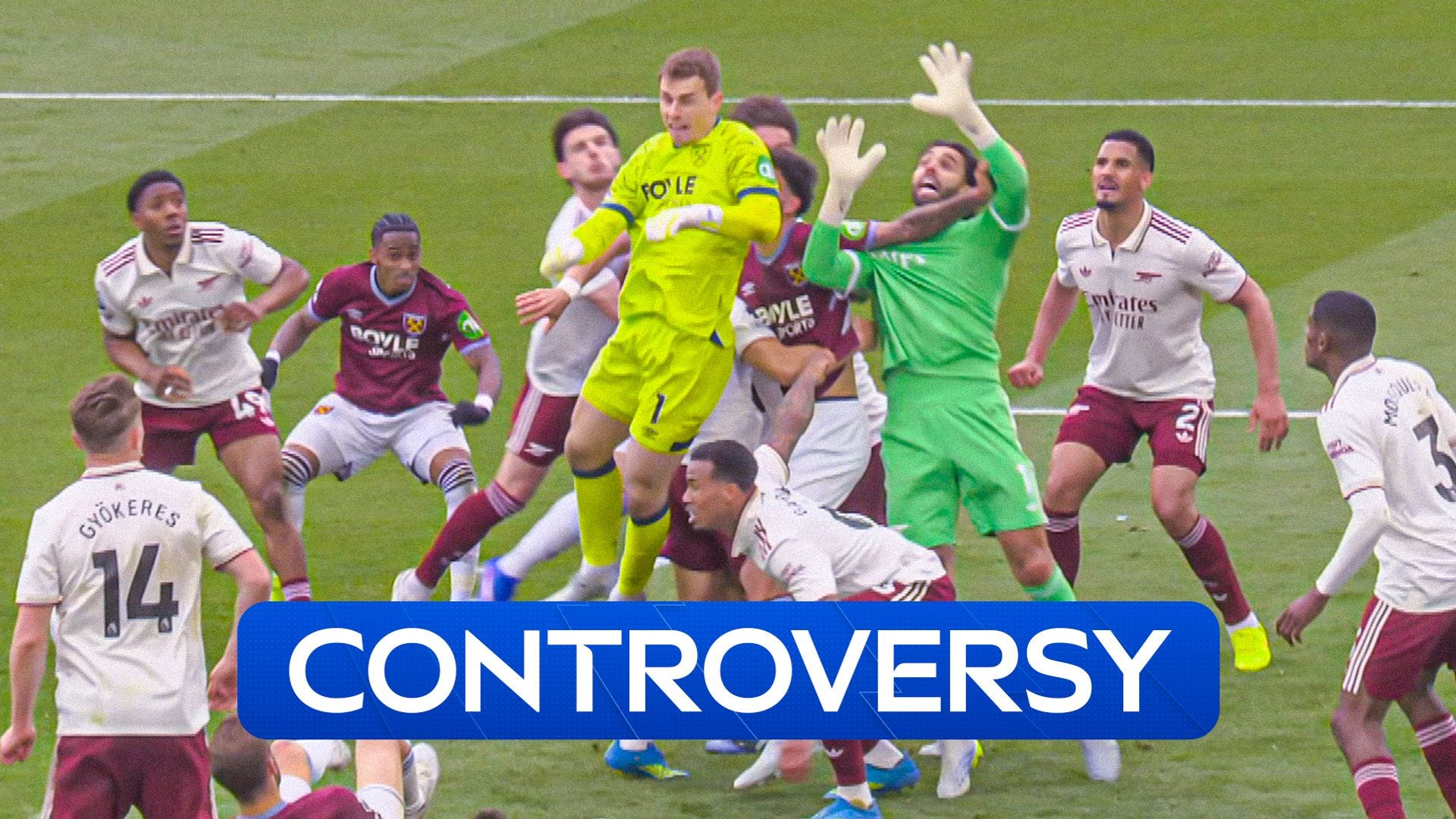
It was probably inevitable wasn’t it? After a season where grappling and holding at set pieces has been a regular talking point, one of the most consequential games of the season was decided by one of those moments.
It seems like everybody has given an opinion. Among the people giving opinions, the greatest irony has been Arsenal fans claiming those who say the decision was wrong are only doing so because of their dislike of Arsenal. Which of course ignores the fact that their opinions are completely influenced by the fact they support Arsenal. The most biased parties in this whole debate are the supporters of the 2 sides involved.
A number of those Arsenal fans have posted still shots of the Raya incident with comments saying it’s incredible there are people who don’t think it’s a foul. That’s debatable, as I’m about to make a case for, but it's equally unfathomable that there are people who believe there was nothing there that warranted a penalty either.
With no bias, the eventual decision they reached was wrong in my opinion. For several reasons really, but the fact that only one team was penalised for all that went on there is the biggest injustice of them.
The first thing to say here is that holding at set pieces was a point of emphasis for officials at the start of this season. Howard Webb made it clear officials were expected to clamp down on the following things.
Referees will analyse instances of holding and assess how severe or extreme they may be, with the criteria including: sustained and/or impactful holding; clear impact on the opponent's opportunity to play or challenge for the ball; and clear non-footballing action with an impact on the opponent's movement.
Besides that, Webb spoke about contact with goalkeepers on one of the ‘Match Officials Mic’d Up’ programmes last season. Discussing why a goal was allowed to stand despite there being contact with the goalkeeper, Webb explained that not all contact would be considered to be a foul. He also emphasised that contact on a keeper in the air would be viewed differently to contact with a keeper on the ground. A keeper with both feet off the ground is obviously in a more vulnerable position than they are with both feet on the ground.
On the opening day of the season, Arsenal scored a goal at Manchester United after clear contact had been made on Altay Bayindir, the United keeper. Based on what Webb had said previously, I wasn’t surprised the goal was allowed to stand. His feet weren’t off the ground and it was the kind of situation where Webb had said the goalkeeper was expected to be stronger.
Slightly more surprising was another goal scored by Arsenal a few months later. When Gabriel scored against Aston Villa, he clearly made contact with Emi Martinez in mid air. That seemed to be an obvious example of a situation where Webb said contact would be dealt with on a stricter basis. However, the fact that the goal was given did seem to indicate a certain amount of contact would be allowed even if the keeper was off the ground.
This isn’t a case of singling out Arsenal. They are involved in their fair share of these sort of incidents though. Maybe that shouldn’t be a surprise for a team that puts so much work into getting an edge at set pieces, both attacking and defensive.
So to the decision on Sunday. Obviously, there was contact on David Raya. At the same time, there was also contact on several West Ham players.
Both Darren Cann, a former assistant referee, and Dermot Gallagher, the former referee, have tried to argue that the fouls were dealt with in chronological order. That quite clearly was not the case. Leandro Trossard had a hold of Pablo from the word go. At that point, Pablo was 5 yards away from Raya and it was his contact on the goalkeeper that appears to have eventually been penalised.
Todibo had hold of Raya’s shirt, but Martin Odegaard already had his arms wrapped around him by then. Declan Rice first had hold of Crysencio Summerville and then more forcibly with Konstantinos Mavropanos.
There was actually a quite comical moment where Myles Lewis-Skelly initially tried to grab Mavropanos, wasn’t strong enough to hold him, and a panicked Rice had to quickly let go of Somerville to grab Mavropanos himself. The contact on Todibo, Pablo and Mavropanos clearly took place before the relevant contact on Raya. Cann and Gallagher do themselves no favours here by taking this line when we are all able to see it for ourselves.
Of the 7 West Ham players in the area at the time, only 2 weren’t pulled or grabbed in some way. Mads Hermansen, who seemed to be left alone because he’s a goalkeeper, and Callum Wilson, who eventually put the ball into the net.
The next point is the level of contact on Raya. At the very start of Pablo’s arm coming across him, Raya was still able to push Gabriel forward to give himself more room and tell him to duck. Gabriel reacted to that call. Pablo was then making contact with Raya’s arm but it wasn’t pulling the arm down. I could understand a foul being given if Raya had missed the ball. He didn’t miss it. He comfortably got 2 hands on the ball, despite the contact from Pablo, and then promptly dropped it. His feet also weren’t off the ground. Of all the people in the media I’ve seen discussing this, I haven’t seen or heard any of them refer to the fact that Raya was able to get both hands to the ball, despite the contact.
Had there been significant force to the contact, Raya shouldn't have been able to get his hands that high in the first place. His arm was able to move to be able to get his hands on the ball. There was no reason for him to drop it. The ball slipped through his fingers and the contact from Pablo wasn’t the cause of that. Raya’s theatrical flop immediately after the drop suggests he realised that as well. It’s dubious whether there was enough contact to make him drop the ball. There certainly was no contact on him to cause him to flop like that.
https://x.com/i/status/2053528967706014013
The problem with VAR is that it invariably reduces decisions to what is seen in slow motion or freeze frames. That gives no context to the level of contact that’s taken place. In real time, there really didn’t look enough to disallow it. Something Chris Kavanagh obviously felt as well given he awarded the goal. Another thing we've heard a lot this season is the concept of contact with consequence. Was this contact enough to make Raya drop the ball having got 2 hands on it?
Incidentally, of all the players being held, Raya was the only one of them who was able to make any challenge for the ball. Which contact had the greatest impact? This is the crucial point here and it falls within that category of a clear impact on the opponent’s opportunity to play or challenge for the ball. Raya was not prevented from getting 2 hands on the ball. Pablo was prevented from making a challenge for the ball by Trossard’s holding. At the same time Mavropanos was being impeded by a clear example of a non footballing movement. A legitimate rugby movement without a doubt, but definitely not a football movement.
Under the guidelines issued by Webb at the start of the season, the holding by Trossard on Pablo meets just about all the criteria for a penalty. The contact was prolonged and it prevented Pablo getting a run at the ball. Trossard also never looked at the ball. His only intention was to hold Pablo. Again that’s the very definition of a non footballing movement and that very obviously happened before Pablo’s contact on Raya.
It should also be pointed out that Raya made a poor decision to come into the crowd. There was always likely to be some contact on him from someone. There is an argument to say Pablo, if allowed an unimpeded run at the ball, would have been able to get there ahead of him.
Jamie Carragher on Monday Night Football fell back on the ‘not enough there for a penalty’ line when discussing that contact. Using that criteria of a clear impact on the opponent’s ability to play or challenge for the ball, what is he saying isn't enough there? Pablo was never able to even make a jump for the ball while Raya was able to get 2 hands on it. One contact had a greater impact on the other in preventing the opponent making a challenge for the ball and it wasn’t the one they said it was.
The time the process took suggests a lot was being discussed. It appears that the incident will be discussed on the next ‘Match Officials Mic'd Up’ programme tonight. It will be interesting to know what exactly was being said and what was being looked at.
Once they were leaning towards disallowing the goal though, everything else that happened in that passage of play automatically becomes magnified. It immediately becomes different to a stand alone decision on whether a penalty should be awarded where the outcome will be penalty or no penalty. In this instance, a goal was about to be taken away from West Ham when several other cases of foul play had happened before, or at the same time, as the incident they were penalising.
The problem isn’t so much that the goal was disallowed. It’s that the final decision determines that was the contact that had the most impact. Despite the fact that incidents of contact on West Ham players met the criteria for a penalty under guidelines given by their own head of match officials.
In the upcoming programme, I fully expect Webb to take the Carragher line of there not being enough there for a penalty. If so, he should have his feet held to the fire about his very own guidelines. Unfortunately, Michael Owen is very unlikely to be the person to do that.
With the delay being so long, I had started to think they would disallow the goal but award a penalty. Mikel Arteta referred to the officials as being brave. Disallowing the goal and giving a penalty would have been the brave call. It also probably would have been the right call. Even that would have put the penalty taker under an almost unbearable level of pressure and it was certainly no guarantee it would have been scored.
I’ve heard some people say the officials have brought this on themselves because of what they’ve allowed to go on all season. They haven’t brought it on themselves, they've brought it on the game itself. The fact that a game with such huge consequences at both ends of the table should be decided like this is a fitting end to a season where the weakness of officials has made football almost unwatchable at times.
The level of thinking involved here was again summed up by Cann, who called for players to be prevented from going into the 6 yard box before the ball is kicked at set pieces. All that would do would be to move the battleground to a different part of the penalty area. Officials already have enough tools to deal with this. It’s the power to penalise it and give penalties when required. That would quickly stop it, just as it did when it was a point of emphasis about a decade ago.
Officials, and former officials in this case, would help themselves if they stopped calling for more and more rules to be brought in and started doing their jobs by using the ones that are already in place.
And you know what will happen in light of this game? Over the next few days they’ll keep telling you this was the right decision, while over the summer they’ll have long discussions about what they’re going to do about the kind of holding that went on here. While they’ll tell you there wasn’t enough there to enforce the rules properly here, the fact that this happened in this game in particular, with all it’s consequences, will very likely lead to another point of emphasis for the new season.
Next season, certainly in the first few weeks of it, there will probably be a number of penalties given with no hesitation for the very same incidents that took place in this game. It will be hidden away in the long grass, but if that does happen it will be the biggest admission that they got it wrong here.
It needs to happen. What has been allowed to go on at set pieces this season can’t be allowed to carry on next season. Watching almost every set piece become a WWE contest when certain teams are involved has become pure tedium. If it takes awarding 4 or 5 penalties a game to stamp it out, so be it.
Thanks for reading.